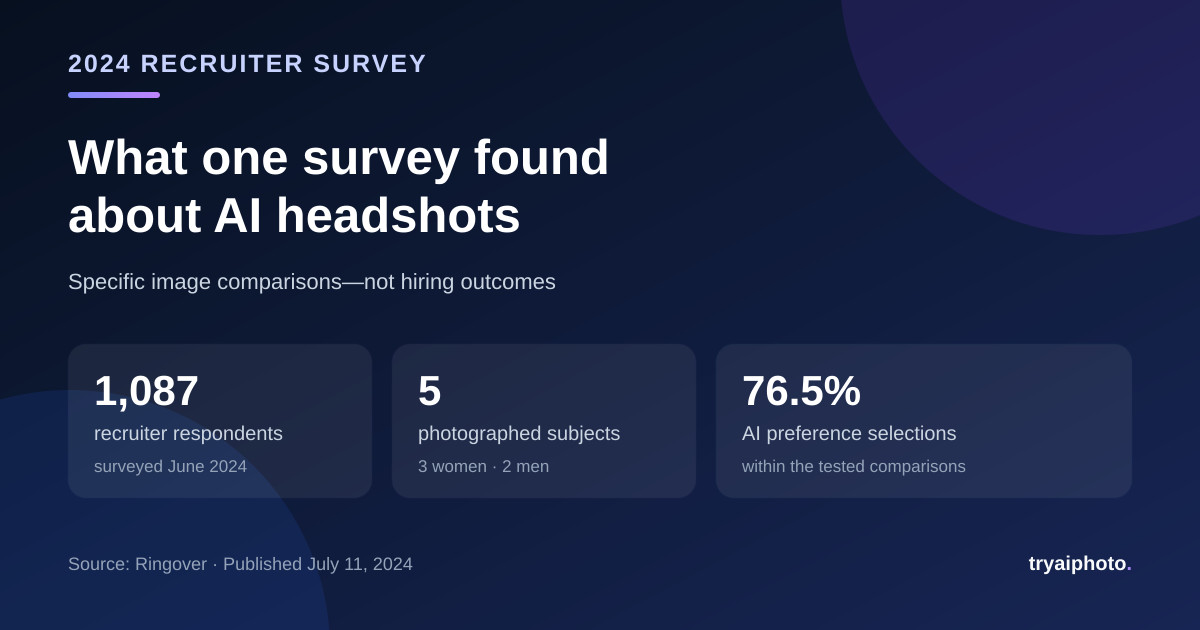
Ringover surveyed 1,087 recruiters and reported that AI-generated headshots received 76.5% of preference selections across its tested image comparisons. That is an interesting result, but it is narrower than saying recruiters generally prefer AI headshots—or that using one improves a candidate’s chance of being hired.
This article summarizes the reported findings, separates preference from hiring outcomes, and explains what the study cannot tell us. Ringover conducted the survey in June 2024 and published its study and methodology on July 11, 2024.
How the five-subject methodology worked
The survey included general questions about headshots, a preference task, an image-identification task, and questions about AI use. Ringover’s methodology named A2E, Remini, PhotoPacks.AI, and Aragon AI. Tryaiphoto was not one of the services tested.
Preference selections in the tested comparisons
In the preference portion, respondents chose among three headshots per applicant without being told that two were AI-generated. Across the five case studies, AI images received 76.5% of selections and real headshots received 23.5%. Ringover further reported 42% for the higher-priced tested AI option and 34.4% for the mid-range tested option.
| Tested image type | Reported price in 2024 study | Selection share |
|---|---|---|
| Higher-priced tested AI service | $35 | 42% |
| Mid-range tested AI service | $9.99 | 34.4% |
| Real headshot | Not an AI-service purchase | 23.5% |
Base: Ringover’s 1,087 recruiter respondents and five photographed subjects. These prices describe the services Ringover selected in June 2024; they are not current market quotes or evidence of a universal price-quality relationship.
What the identification task reported
In the later identification task, Ringover reported that 39.5% of responses correctly identified whether a headshot was AI-generated or real, 52.9% were incorrect, and 7.6% selected “couldn’t tell.” Report that measured distribution directly: the design included real images, multiple AI variants, and a third response option, so a simple 50% random-guessing baseline is not justified by the published methodology.
| Response outcome | Reported share | What it means |
|---|---|---|
| Correct | 39.5% | The response matched the image category. |
| Incorrect | 52.9% | The response did not match the image category. |
| Couldn’t tell | 7.6% | The respondent selected the uncertainty option. |
| Self-rated accurate or very accurate | 80% | A separate self-assessment reported after the task. |
Base: Ringover’s reported sample of 1,087 recruiters; no per-question base is shown on the published page. The 80% self-assessment is not an additional detection-accuracy measure.
Disclosure, recognition, and company use are different questions
Ringover reported three separate attitudes: 88% thought candidate use of an AI headshot should be made clear; 66% said they would be put off if they recognized a candidate’s headshot as AI-generated; and 88% thought AI headshots could be a good idea for use in their company.
Base: Ringover’s reported sample of 1,087 recruiters; the published page does not give per-question response counts.
Those findings do not show that disclosure caused the negative reaction. Recognition and disclosure are not the same intervention, and the company-use question concerns a different context from evaluating an individual candidate. The survey supports describing a tension in reported attitudes rather than claiming that disclosure caused a negative response.
Practical Tradeoffs: Cost, Time and Variety
The survey did not measure return on investment. It also did not compare turnaround time, output counts, printing, or customer satisfaction across the tested services. Those factors can still matter, but they require current provider terms or photographer quotes rather than extrapolation from preference selections.
| Factor | What the Ringover study provides | What to verify now |
|---|---|---|
| Cost | June 2024 prices for four tested AI services and a cited photographer range of $150–$450 | Current total price, taxes, retakes, and usage rights |
| Time | Not measured | Booking, processing, review, and revision time |
| Variety | Not measured | Number of usable outputs, outfits, backgrounds, and revisions |
| Outcome evidence | No interviews, offers, or hires measured | Do not treat image preference as a hiring-performance claim |
Dated source: Ringover’s July 11, 2024 article and June 2024 methodology. Prices and product terms may have changed.
A cautious way to use any headshot
- Use an image that remains recognizable as you and fits the professional context.
- Inspect eyes, glasses, hair edges, clothing, and background details at profile size.
- Follow the platform, employer, or application rules that apply to your use.
- Do not imply a workplace, role, credential, or event that is not real.
- Evaluate providers on current terms and your own outputs—not on a study that did not test them.
About Tryaiphoto: Tryaiphoto was not included in Ringover’s study. Any Tryaiphoto output should be reviewed on its own likeness, detail, context, and suitability. This article does not claim recruiter approval or improved hiring outcomes.
Frequently asked questions
Did the 2024 Ringover survey test Tryaiphoto?
No. Ringover named A2E, Remini, PhotoPacks.AI, and Aragon AI in its methodology. The survey does not establish results for Tryaiphoto.
Did the survey measure interviews, offers, or hiring outcomes?
No. It measured survey responses and preferences among specific images. It did not track candidate interviews, offers, or employment outcomes.
Does the survey prove recruiters prefer AI headshots in general?
No. Its visual test used five photographed subjects and images from four AI services. The result applies to those tested comparisons and does not establish a universal preference across industries, countries, demographics, or current models.
Did disclosure cause recruiters to react negatively?
The published results do not establish that. Ringover separately reported attitudes about disclosure, recognition, and company use, but did not report a causal disclosure experiment.
Source and editorial review
Primary source: Ringover, “Does an AI headshot make you more hireable?” Survey conducted June 2024; published July 11, 2024. This Tryaiphoto analysis was source-checked and materially revised by the Tryaiphoto Editorial Desk on August 11, 2026.
Evaluate a headshot preview on its own merits
Tryaiphoto was not tested in the Ringover survey. If you explore a preview, compare it with your source photo and review likeness, artifacts, and context before deciding whether to use it.
Explore Headshot Creator